
YES Bank, Bank of Baroda, SBI, IndusInd Bank, and RBL Bank are amongst the banks, Jefferies says, are most prune to "high risk" emanating from ADAG, Cox & Kings, CG Power, DHFL and Essar Shipping.

If a retail investor wants exposure to a healthcare ETF, it should be a part of his satellite portfolio, suggests Sanjay Kumar Singh.

'To the believers of crypto regulations, I have only one question to ask, how will you regulate it?'

'TMFs trump FMPs and FDs when it comes to investing in a high-duration product.'

rediffGURU Ramalingam Kalirajan answers your personal finance queries.

Do you have financial planning queries? Ask rediffGURU Anil Rego.
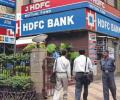
This will be the lender's first result after its merger with HDFC Ltd, effective from July 1, and will keep analysts glued to the management's earnings growth guidance for the merged financial behemoth.

The Reserve Bank has found gaps in banks' corporate governance despite issuing guidelines on the matter, Governor Shaktikanta Das said on Monday. Addressing directors of bank boards, Das said such gaps, which have been mitigated, could have caused "some degree of volatility". He also hit out strongly against "smart accounting" to conceal stress and bloat financial performance.

Despite strong AUM growth, MFs lag behind other popular investment avenues. MFs received only 6 per cent of total household savings in 2021-2022.

'The prime minister's comment on 'revdi culture' was welcome. But I am disappointed he did not follow up on that.' 'All political parties, including the BJP, have been guilty of this.' 'Now, Modi's guarantees, the Congress's 'nyay' path and both ruling and Opposition parties are vying with each other for freebies in my home state Andhra Pradesh.'

The RBI's financial stability report has on Wednesday highlighted the disconnect between the real economy and equity market yet again. The central bank observed that Indian equities were trading at rich valuations, with several metrics such as price to earnings multiples, price to book ratio, market cap to GDP and the cyclically adjusted P/E ratio, or Shiller P/E, at above historical averages. For instance, as on December 13, the one-year forward P/E ratio for India was 35.1 per cent, above its 10-year average, and one of the highest in the world.

Investors can sell their entire equity and move to debt when stocks get expensive

Retail investors now own a bigger slice of small-cap companies than a couple of years earlier, attributable to their growing conviction in mutual fund (MF) schemes focused on this space. Data from Capitaline shows MFs' average holding in the National Stock Exchange Nifty Smallcap 250 rising to 8.67 per cent, from 7.67 per cent in the past two financial years, with the number of companies with over 20 per cent MF holdings, rising from 15 to 24. At the end of May, the top five small-cap firms with the highest MF holdings were Carborundum Universal, Blue Star, Cyient, Gujarat State Petronet, and Cholamandalam Finance.

'A key reason for the strong interest in IPOs has been an increased focus on profitability and reasonable pricing of deals.'

The bank, which has suffered reverses following a massive spike in dud assets and also the dismissal of its chief executive Chanda Kochhar over governance issues, however, hinted that the worse is behind.

'There is no reason why we should break this business up.'

The challenge for the RBI in 2024 is likely to be less about containing elevated inflation and more about curbing excessive financial market exuberance and a 'problem of plenty', notes Sajjid Chinoy, Chief India Economist JP Morgan.

'I found it unbelievable that L&T said 45,000 jobs were waiting to be filled because of unavailability of suitable skillsets.' 'So, when the Opposition sweepingly says there are no jobs, I'm sorry... I'm not saying it's raining jobs, but there are jobs. The (skill) gap has to be bridged.'

However, the number of renewals has grown by only 0.4 per cent, which means only high value and ticket size renewals are coming.
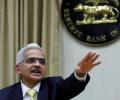
'The banking sector appears to be on course to recovery,' declares the RBI governor.

In rupee terms, India's market cap is currently about Rs 184 trillion - 90 per cent of the GDP of Rs 203 trillion for FY20 at current prices.

Don't exit from growth-style funds as they may benefit next from a shift in investor preference.

'Very few of small investors stay invested for those three or four or five years.' 'If there's like a six month, one-year period when market is not doing well, you exit.' 'After the market has run up, you get in again.' 'This way you will never make returns.'

The market breadth has turned sharply positive since May amid hopes that a decline in Covid-19 infections will lead to a revival in the economy. At 3.8, the advance-decline ratio (ADR) for May was the best since June 2020. So far this month, the ratio has remained above three - in simpler words, for every declining stock, there were nearly four advancing stocks in May and three this month. ADR is a popular market breadth indicator, with a ratio of more than two signalling an extremely bullish undercurrent.

In 2019-20, the capital expenditure of Indian Railways (IR) increased 60 per cent over 2016-17. The draft National Railways plan envisages a further increase in IR's capital expenditure, but an analysis by Business Standard shows that IR has come to depend more on borrowings and budgetary support. In 2016-17, while 11 per cent of its capital expenditure (capex) was funded by internal sources, in 2019-20 the ratio dropped to less than 1 per cent. A 2015 Committee on Restructuring Railways had flagged that over-reliance on borrowings could exacerbate the financial situation of Railways.

Believe it or not, the regulator is even stretching its arm to identify stressed borrowers and gauge the 'distance to default' as a measure of a particular bank's fragility, reveals Tamal Bandyopadhyay.

Is the worst over for Indian banks? The past two years saw them ride on treasury trades as deposits soared and credit growth dipped sharply. Gross and net non-performing assets (NPAs) moved south, and the provision coverage ratio (PCR), capital buffers, and profitability indicators are back at pre-pandemic levels. So, what's the plot ahead?

'In a serious fiscal situation like this, an ostrich-like focus on annual budgeting, event management and defensive rhetoric will only make matters worse,' warns Rathin Roy.

One thing is for sure: It smacks of the regulator's lack of confidence in the bank's board, points out Tamal Bandyopadhyay.

Merely bringing down the government stake below 51% may not find any taker for the PSBs. The government must bring down its holding to at least 26%, recommends Tamal Bandyopadhyay.

Indian Bank expects recoveries to be more than slippages in this financial year, which will result in improved asset quality.

On November 12, 2021, the Reserve Bank of India (RBI) decided to ring in uniformity in asset classification and income recognition across all lending institutions. Shadow banks, or non-banking financial companies (NBFCs), like commercial banks, are to test non-performing assets (NPAs) on a daily basis and upgrade them to "standard assets" only when interest and principal arrears are settled by borrowers. This is going to create all manner of headaches for shadow banks and their clientele. Says Y S Chakravarti, managing director and chief executive officer (CEO), Shriram City Union Finance: "NPA levels will go up, especially of small borrowers.

Axis Bank's acquisition of Citibank's consumer finance business for Rs 12,325 crore - the second biggest deal in the Indian banking sector - is seen as a good deal at a good price. The acquisition enables Axis Bank to close the gap with competition in some key segments such as credit cards. At the same time, there are some key issues that are crucial for the deal's success, apart from the fact that it will take some time for Axis to reap the full harvest of its investment.

Analysts say strengthening bank's capital will boost earnings, bank needs chief with long stint to run show

Given the uncertain macroeconomic conditions, most brokerages have turned slightly cautious on the pace of growth in State Bank of India's (SBI's) earnings going ahead. While they don't see any significant risk arising for now, its sheer balance sheet size and systematic importance has nudged them to cut earnings estimates for fiscal year 2023-24 (FY24) and 2024-25 (FY25) up to 5 per cent. India's largest state-owned bank, on Thursday, reported standalone net profit of Rs 16,694.51 crore for Q4FY23.

Gold has held up better than many expected.

That's the only way to convince those who have money to return to the bank fold, ditching other asset classes, says Tamal Bandyopadhyay.

Currently, banks are closed every second and fourth Saturday of a month. Why shouldn't they be shut every Saturday? When most customers carry their banks in their pocket (the app on the mobile phone), there is no need to keep banks open on Saturdays, argues Tamal Bandyopadhyay.

'Chasing sectors which have reported strongest earnings is not always the right strategy for outperformance.'

MMFs are a good option for the current environment, observes Sarbajeet K Sen.
